What are the differences between outdoor and indoor self-service kiosks?
Dec 21, 2025The global shift toward automation is no longer a trend—it’s the standard. From fast-food chains to retail giants, businesses are deploying self-service payment kiosks to slash wait times and reduce labor costs. However, one of the most expensive mistakes a business owner can make is choosing the wrong environment for their hardware.
Should you invest in an indoor kiosk or a rugged outdoor model? While they may look similar on the surface, the internal engineering is worlds apart.
Based on the latest innovations from Aonpos, here are the five critical differences between indoor and outdoor self-service kiosks.
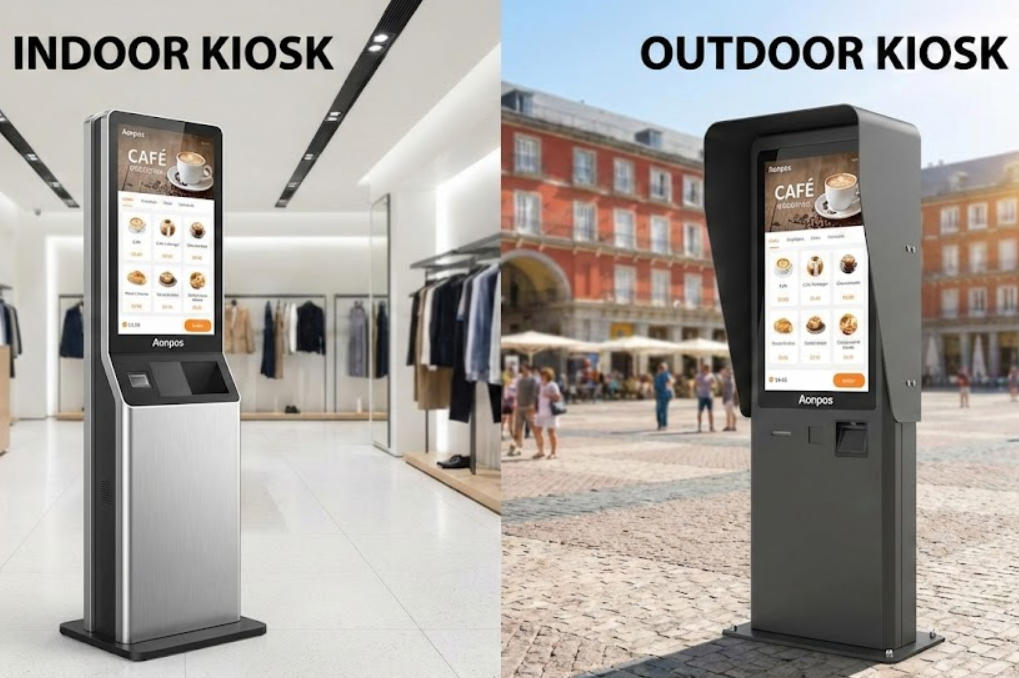
The most obvious difference is environmental protection. An indoor kiosk, like the Aonpos AP022, is designed for climate-controlled environments like malls or restaurants. It uses high-quality aluminum alloy and ABS plastic to maintain a sleek, professional look.
In contrast, an outdoor kiosk must withstand rain, snow, and dust. High-end models feature an IP65 rating, meaning they are completely dust-tight and protected against water jets. Aonpos has pioneered "modular waterproof" designs that allow these machines to operate in demanding "Coffee Pop-Up" or outdoor market scenarios without risking internal circuitry.
Have you ever tried to read your phone screen in direct sunlight? It’s nearly impossible.
Indoor Kiosks: Usually feature a brightness of 250 to 300 nits, which is perfect for indoor lighting.
Outdoor Kiosks: Require high-brightness panels, often exceeding 1500 nits, paired with anti-glare tempered glass.
Aonpos utilizes true-flat 10-point capacitive touch screens across their lineup, ensuring that whether your kiosk is a 15.6-inch desktop unit or a 32-inch floor-standing giant, the touch response remains fluid and the visuals remain crisp.
Indoor environments are stable, usually staying between 0°C and 40°C. Outdoor kiosks, however, face the "greenhouse effect"—sunlight hitting the glass can cook the internal CPU.
To combat this, outdoor units often include internal HVAC systems or advanced fan cooling. Aonpos hardware is engineered for 24/7 commercial use, featuring a "Watchdog Timer" (WDT) and industrial-grade processors (from Intel J4125 to high-performance i5/i7) that maintain stability even when temperatures fluctuate between -15°C and 50°C.
Indoor kiosks are often monitored by staff. Outdoor kiosks are often left unattended overnight. Outdoor models require:
Thicker Steel Enclosures: To prevent forced entry.
Security Locks: Multi-point locking systems for cash and component access.
Bolted Bases: To ensure the unit cannot be moved.
Aonpos offers modular architecture, allowing businesses to choose between lightweight stands for indoor retail or heavy-duty, reinforced bases for public squares.
Whether indoor or outdoor, your kiosk needs to grow with your business. This is where Aonpos excels. Their "Lego-like" modular design allows you to swap components easily:
Payment: Integrate NFC, QR code scanners, or traditional card readers.
Printing: Choose between 58mm or 80mm thermal printers with auto-cutters.
Verification: Add ToF cameras for facial recognition or ID scanners.
Choose Indoor if you are running a restaurant, hotel lobby, or retail checkout where the environment is stable and space is a premium.
Choose Outdoor if you are offering 24/7 services such as ticketing, drive-thru ordering, or outdoor pop-up events.
Aonpos provides factory-direct, customizable self-service solutions designed to improve efficiency and customer satisfaction. Whether you need a wall-mounted indoor terminal or a rugged outdoor payment kiosk, our modular systems are built to perform.
Explore the Aonpos Kiosk Range Today
Q: Can I use an indoor kiosk in a semi-outdoor area? A: It is not recommended unless the area is completely protected from humidity and temperature extremes. Using an indoor kiosk in a semi-outdoor setting can void warranties and lead to screen fogging or hardware failure.
Q: What is the best screen size for a self-service kiosk? A: For retail and restaurants, 21.5-inch and 27-inch screens are the industry standard as they offer the best balance between visibility and space-saving.
Q: Are Aonpos kiosks compatible with Windows and Android? A: Yes. Aonpos kiosks support Android 7.1 through 11 and Windows 7, 10, and 11, allowing for seamless integration with your existing POS software.
Tel / Whatsapp : +86 -15999943922
Email : nikki@aonpostech.com


© 2026 Shenzhen Aonpos Technology Co., Ltd .All Rights Reserved