How to Import POS Machines from China: A Practical Guide for International Buyers
Nov 15, 2026China has become a major sourcing destination for POS hardware, supplying everything from compact touchscreen cash registers to dual-screen terminals and self-service kiosks. For distributors, retail technology companies, and POS solution providers, buying directly from Chinese manufacturers can offer greater control over product specifications, branding, and procurement costs.
However, importing POS machines involves more than negotiating a factory price. Hardware compatibility, supplier reliability, product certification, shipping arrangements, and after-sales support all influence whether an overseas purchase becomes a profitable long-term partnership.
To import POS machines from China successfully, buyers should define their hardware requirements, verify the manufacturer, test samples, confirm destination-market compliance, calculate landed costs, and establish clear production and shipping terms before placing a bulk order.
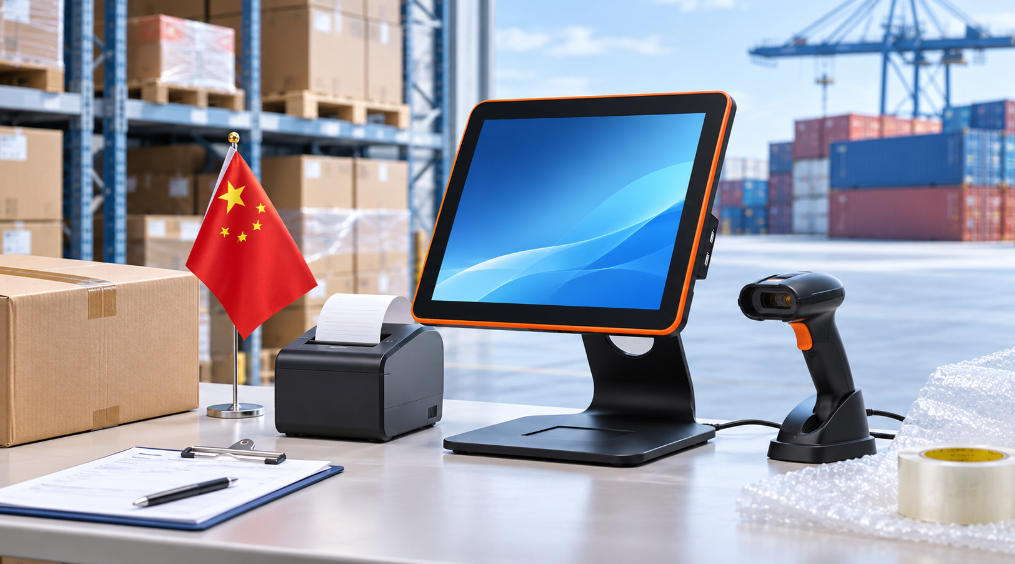
One of the most common purchasing mistakes is requesting quotations without providing detailed technical requirements.
Two terminals may look almost identical while using different processors, touch panels, motherboards, and connectivity options. These differences can significantly affect software compatibility and service life.
Before approaching manufacturers, prepare a specification sheet covering:
Operating system: Windows, Android, or Linux, depending on software requirements.
Processor: CPU performance appropriate for the intended application.
Display: Screen size, resolution, touch technology, and single- or dual-screen configuration.
Memory and storage: RAM and SSD capacity based on application requirements.
Connectivity: USB, serial ports, Ethernet, Wi-Fi, Bluetooth, and other required interfaces.
Peripherals: Receipt printers, barcode scanners, cash drawers, and customer displays.
Installation: Desktop, wall-mounted, or integrated kiosk configurations.
Software compatibility deserves particular attention. A POS terminal that works perfectly with one restaurant application may not support another company's printer drivers or specialized peripherals.
Buyers should also consider regional requirements, including power adapters, operating languages, and wireless connectivity standards.
Manufacturers such as AONPOS offer different configurations through their POS machine product range, allowing buyers to compare hardware options before requesting samples.
A detailed specification sheet makes quotations easier to compare and reduces the possibility of receiving equipment that cannot support the intended deployment.
Chinese POS suppliers generally fall into three categories: manufacturers, trading companies, and businesses combining production with sourcing services.
None of these arrangements is automatically unsuitable. The important question is whether the supplier can consistently deliver the required product and provide technical support when something goes wrong.
For buyers planning repeat orders or private-label products, direct manufacturing relationships can offer advantages in configuration control and product development.
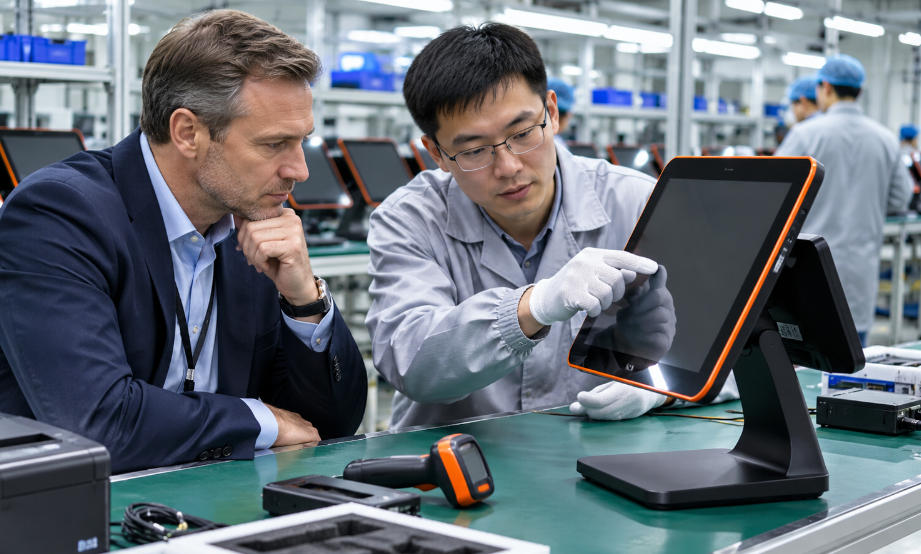
Start by reviewing the company's business information, product specialization, manufacturing capabilities, and export experience.
Ask practical questions:
Does the company manufacture POS terminals or mainly resell finished products?
Can it provide detailed hardware specifications and component information?
Are replacement parts available for previously purchased models?
Can the supplier maintain consistent configurations across repeat orders?
What technical support is available after delivery?
A factory visit or independent third-party inspection can provide additional confidence before a substantial purchase.
Communication quality also matters. Suppliers that respond clearly to technical questions, acknowledge limitations, and document agreed specifications are generally easier to work with during complex projects.
For long-term distributors, product continuity may be more valuable than obtaining the lowest initial quotation.
Not every importer needs a fully customized terminal.
Standard POS hardware is often suitable for businesses purchasing equipment for their own stores or distributing existing product models.
OEM and ODM arrangements become more relevant when buyers want to establish a branded product line or serve specialized applications.
|
Sourcing option |
Suitable buyers |
Main considerations |
|---|---|---|
|
Standard POS |
Retailers, smaller resellers |
Existing specifications, faster deployment |
|
OEM POS |
Distributors, POS software brands |
Logo, packaging, configuration options |
|
ODM POS |
Larger integrators, specialized projects |
Engineering, tooling, development time |
OEM projects commonly involve using an established hardware platform with selected components, branded packaging, or customized appearance.
ODM development may require changes to the enclosure, motherboard layout, display arrangement, or peripheral integration.
Before agreeing to customization, clarify minimum order quantities, development charges, sample approval procedures, and ownership of custom designs.
For most businesses entering a new market, starting with an established hardware platform is often a more manageable approach than commissioning an entirely new device.
Certification requirements depend on the destination country, hardware configuration, and incorporated technologies.
A POS terminal containing wireless communication modules may face different regulatory requirements from a basic wired touchscreen computer.
For example:
United States: Electronic devices may be subject to FCC equipment authorization requirements, depending on their radio-frequency characteristics. Buyers should check the compliance status of the complete configuration rather than assuming that an approved wireless module automatically resolves every requirement.
European Union: Applicable CE-marking legislation may include electromagnetic compatibility, radio equipment, electrical safety, and RoHS requirements. EU importers also have responsibilities for verifying conformity documentation and product traceability.
Other markets: Countries may require additional electrical safety approvals, wireless certifications, registration, or localized documentation.
Request relevant test reports, declarations of conformity, and product identification details before shipment.
It is equally important to confirm whether documents cover the exact model being purchased, including any major hardware modifications.
Certification should be treated as part of product selection, not as paperwork to address after production.
A sample order provides an opportunity to identify problems before committing to a larger shipment.
Rather than checking only whether the terminal powers on, test it with the actual POS software and peripheral devices intended for deployment.
Recommended evaluations include:
Touchscreen accuracy and responsiveness
Software installation and operating stability
Receipt printer and barcode scanner connectivity
Ethernet and wireless network performance
Continuous operation under normal workloads
Power supply reliability
Physical construction and packaging protection
Where possible, operate the sample for several days in a realistic checkout environment.
Pay attention to heat, unexpected restarts, disconnected peripherals, and driver conflicts.
If the sample passes, document its configuration and establish it as the approved reference for production.
For customized projects, confirm that the mass-produced units will match the approved sample, including internal components and firmware versions.
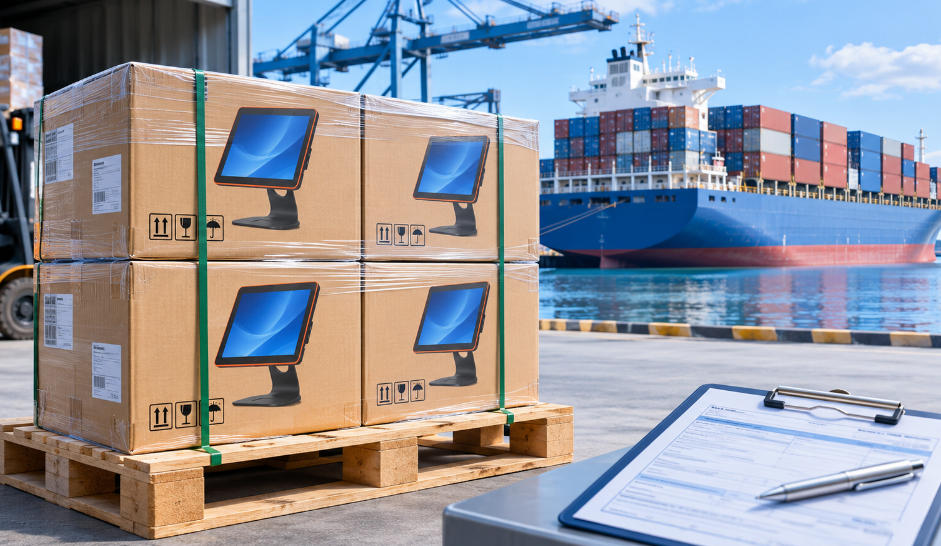
The factory quotation is only one part of the final purchasing cost.
A terminal advertised at a competitive price may become considerably more expensive after transportation, customs clearance, taxes, and local distribution expenses.
Importers should calculate the total landed cost rather than comparing suppliers solely on unit prices.
|
Cost component |
What to include |
|---|---|
|
Product cost |
Terminal, accessories, customization |
|
Export packaging |
Cartons, protective materials, pallets |
|
Freight |
International transportation and handling |
|
Import charges |
Applicable duties, tariffs, taxes |
|
Customs clearance |
Brokerage and processing fees |
|
Local delivery |
Port-to-warehouse transportation |
|
Service allowance |
Spare parts, warranty handling, returns |
For example, a buyer purchasing 100 terminals at $220 each has an initial equipment cost of $22,000.
If freight, clearance, duties, taxes, and local handling add another $4,000, the total landed cost becomes $26,000, or $260 per terminal.
This is an illustrative calculation, not a market quotation.
Actual import charges depend on the destination, tariff classification, customs value, origin, and applicable trade measures. A customs broker can help verify the relevant classification and charges before ordering.
Shipping arrangements should reflect order quantity, delivery urgency, and the buyer's logistics experience.
Air freight is often appropriate for samples and urgent small shipments, while sea freight may be more economical for larger commercial orders.
Common trade terms include:
EXW (Ex Works): The buyer assumes responsibility for most transportation arrangements and costs from the agreed factory location.
FOB (Free on Board): Commonly used for sea freight, with responsibility transferring according to the agreed port and Incoterms rules.
DAP (Delivered at Place): The seller arranges transportation to the named destination, while import clearance and applicable import charges generally remain the buyer's responsibility.
DDP (Delivered Duty Paid): The seller assumes broader delivery and import responsibilities, including applicable import duties, under the agreed terms.
Buyers should always specify the named place and Incoterms version in the contract.
For first-time importers, working with an experienced freight forwarder and customs broker can simplify coordination.
Do not assume that a door-to-door shipping quotation automatically includes all customs responsibilities.
International hardware orders typically involve several stages: quotation approval, sample confirmation, deposit, production, inspection, and final shipment.
Payment arrangements vary according to supplier relationships, order size, and customization requirements.
Before transferring funds, verify the supplier's registered business name and bank account details using an independently confirmed communication channel.
The purchase agreement should identify:
Exact product models and specifications
Quantity, unit price, and currency
Approved sample or configuration reference
Production and delivery schedule
Inspection and acceptance criteria
Warranty conditions and spare-part arrangements
Shipping terms and required documentation
For larger orders, consider a pre-shipment inspection to verify quantities, appearance, functionality, labels, and packaging.
A shipment inspection cannot replace thorough sample testing, but it can catch visible manufacturing or packing problems before the goods leave China.
Most commercial POS hardware shipments require a commercial invoice, packing list, and transport document, such as an air waybill or bill of lading.
Depending on the destination, additional documents may include certificates of origin, compliance records, import declarations, or other regulatory paperwork.
The product description should accurately identify the equipment rather than using vague terms such as “electronic accessories.”
Buyers should confirm the correct Harmonized System classification with their customs broker. The final tariff code can depend on the device's functions and national tariff schedule.
In the United States, the importer of record remains responsible for the accuracy of customs information and applicable duties, even when a broker handles the filing.
Good documentation reduces the risk of customs delays, unexpected charges, and disputes over shipment contents.
Importing POS equipment is rarely a one-time transaction for distributors and system integrators.
Customers expect replacement devices, consistent performance, and repairs long after the original shipment arrives.
Before confirming a supplier, discuss warranty coverage, replacement procedures, remote troubleshooting, and the availability of critical parts such as touch panels, power adapters, and motherboards.
It is also worth asking how the manufacturer manages component changes.
A processor or motherboard revision may appear minor from a manufacturing perspective but could affect POS software compatibility.
For businesses supplying multiple locations, consistent hardware configurations can reduce maintenance expenses and simplify technical support.
Keeping a small inventory of replacement parts locally may also help avoid lengthy service interruptions.
For overseas buyers seeking a manufacturing partner in China, AONPOS provides POS hardware for retail, hospitality, and other commercial applications.
Established in Shenzhen in 2012, the company focuses on touch POS terminals, self-service kiosks, monitors, barcode scanners, printers, and related checkout equipment.
AONPOS supports OEM and ODM cooperation, including selected hardware configurations and product customization according to project requirements.
Its product portfolio allows distributors and integrators to source multiple categories of checkout equipment through one supplier, potentially simplifying hardware selection and procurement communication.
Buyers can learn more about the company's manufacturing background and product capabilities through the AONPOS company profile.
For international partners, the practical starting point is to share software requirements, target market, estimated quantities, and preferred configurations so that technical feasibility, sampling, and commercial terms can be evaluated before production.
Yes. Businesses can purchase POS machines directly from Chinese manufacturers, provided the products meet the applicable import and regulatory requirements of the destination market. Working with a customs broker is advisable when the buyer is unfamiliar with local procedures.
Minimum order quantities vary by manufacturer, model, and customization requirements. Some suppliers accept individual sample orders, while private-label or custom-developed products may require larger quantities.
Delivery time depends on product availability, customization, production scheduling, shipping method, and customs clearance. Buyers should obtain separate estimates for manufacturing and international transportation rather than relying on a single delivery promise.
Many manufacturers offer OEM branding, including logo application and customized packaging. More extensive changes to housing, hardware, or firmware may require an ODM arrangement.
Not necessarily. Many manufacturers primarily supply hardware, while POS software companies or system integrators install and configure their own applications. Buyers should confirm software licensing, operating system availability, and driver compatibility before purchasing.
Importing POS machines from China can be a practical way for distributors, software providers, and commercial equipment suppliers to expand their product offerings.
The greatest risks usually come from incomplete specifications, insufficient testing, unclear commercial terms, or overlooked compliance requirements rather than the international purchasing process itself.
A reliable sourcing strategy starts with choosing hardware that supports the intended software, followed by manufacturer verification, sample testing, regulatory checks, and a realistic landed-cost calculation.
For buyers exploring a direct manufacturing relationship, AONPOS offers a range of POS terminals and related hardware, with OEM/ODM options for different commercial projects.
The objective is not simply to import equipment at a lower price. It is to establish a dependable hardware supply chain that can support customers, repeat orders, and future business growth.
Tel / Whatsapp : +86 -15999943922
Email : nikki@aonpostech.com


© 2026 Shenzhen Aonpos Technology Co., Ltd .All Rights Reserved