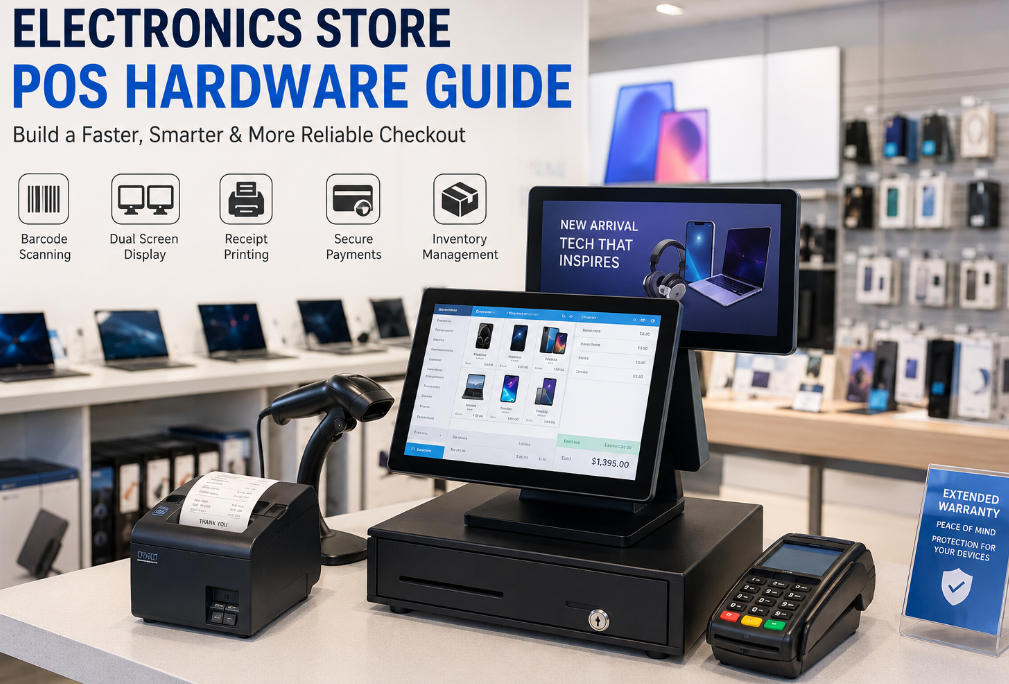
Electronics Store POS Hardware Guide: How to Choose the Right System
Jul 14, 2026
Electronics retail is more complex than ordinary product checkout. A typical electronics store may sell smartphones, computers, accessories, home appliances, replacement parts, warranties, installation services, and high-value products with unique serial numbers.
Because of this complexity, selecting the right electronics store POS hardware requires more than choosing a touchscreen and connecting a receipt printer. The hardware must support fast transactions, detailed inventory control, product identification, customer engagement, peripheral integration, and long-term expansion.
This guide explains the essential hardware components of an electronics retail POS system, the specifications buyers should evaluate, and how retailers, distributors, and system integrators can build a reliable checkout solution.
What Is an Electronics Store POS System?
An electronics store POS system is a combination of hardware and software used to process transactions and manage retail operations in an electronics shop.
Depending on the software platform, the system may help a retailer:
Process cash, card, mobile, and contactless payments
Scan product barcodes and QR codes
Track stock levels across departments or locations
Record serial numbers, IMEI numbers, or warranty information
Manage returns and product exchanges
Create customer profiles
Apply promotions and bundled pricing
Monitor employee activity
Generate sales and inventory reports
Synchronize physical-store and online inventory
The software handles business logic and data, while the hardware provides the physical interface through which employees and customers complete transactions.
A reliable electronics store POS hardware platform should therefore be selected according to operational requirements rather than appearance alone.
Why Electronics Stores Need Specialized POS Hardware
Electronics retailers face several challenges that may not be common in smaller or lower-volume retail environments.
High-Value Inventory
Many electronic products have a high unit value. Inventory discrepancies, incorrect product selection, and unrecorded returns can create significant losses.
A POS terminal must work reliably with barcode scanners, inventory databases, label printers, and product-tracking applications.
Complex Product Information
Electronics stores often manage multiple models, specifications, colors, storage capacities, accessories, and warranty options.
The POS hardware must provide enough processing performance and display space for staff to search product databases and compare variations without slowing down the checkout process.
Serial Number and IMEI Tracking
Smartphones, tablets, computers, and other devices may require unique serial number tracking. The POS setup should support scanners capable of reading the relevant barcode formats and transferring the information accurately into the retail software.
Returns and Warranty Services
Electronics retailers frequently handle returns, repairs, exchanges, extended warranties, and after-sales service.
Employees may need to retrieve previous orders, verify product information, record serial numbers, and print service documents. A responsive touchscreen terminal and reliable peripheral connections can make these processes much more efficient.
Omnichannel Retail Operations
Many electronics stores sell through physical locations, websites, marketplaces, and social commerce channels.
Although omnichannel functionality is mainly controlled by software, the POS hardware must provide the processing power, connectivity, and operating-system compatibility required to run integrated retail applications.
Essential Electronics Store POS Hardware
A complete POS station normally includes several connected components. The exact configuration depends on store size, transaction volume, product range, and software requirements.
1. All-in-One Touchscreen POS Terminal
The POS terminal is the central component of the checkout station. It runs the retail software and connects scanners, printers, cash drawers, customer displays, and payment devices.
An all-in-one terminal combines the computer, touchscreen, and enclosure into one commercial device. Compared with a traditional desktop computer, this design generally requires less counter space and creates a cleaner checkout environment.
For most electronics stores, important terminal features include:
Commercial-grade capacitive touchscreen
Intel or ARM processor options
SSD storage
Sufficient RAM for the selected POS software
Multiple USB and serial ports
Ethernet and Wi-Fi connectivity
Stable Windows or Android support
VESA mounting compatibility
Easy maintenance and component access
A 15-inch or 15.6-inch screen is suitable for many standard checkout counters because it provides enough room for product search, inventory information, customer records, and transaction controls.
Businesses comparing configurations can review the AONPOS range of all-in-one POS systems, including single-screen and dual-screen hardware for different retail environments.
2. Barcode Scanner
A barcode scanner is essential for fast and accurate product identification.
Electronics stores may need to scan:
Standard UPC and EAN product barcodes
2D QR codes
Serial number labels
IMEI labels
Product packaging with small or dense barcodes
Loyalty cards
Digital coupons displayed on smartphones
A basic 1D scanner may be sufficient for a small accessories shop. However, a 2D area-imaging scanner is generally more versatile for electronics retail because it can read both traditional barcodes and QR codes.
For high-volume counters, a presentation scanner allows employees to move products in front of the scanner without repeatedly picking up a handheld device. A handheld scanner may still be useful when scanning larger products or labels positioned in difficult locations.
The scanner should be tested with the retailer’s actual products, software, and label formats before large-scale deployment.
3. Customer-Facing Display
A customer display improves transparency during checkout by showing product names, quantities, prices, discounts, loyalty information, and the final transaction total.
In an electronics store, the second screen can also be used for:
Warranty options
Accessory recommendations
Membership enrollment
Promotional campaigns
Financing information
Digital receipts
Customer confirmation
Brand advertisements
A dual-screen system creates opportunities for customer communication without requiring extra counter equipment.
The AONPOS product range includes commercial dual-screen terminals with configurable processors, memory, storage, and peripheral interfaces, making them suitable for retail checkout projects that require both cashier and customer interaction.
For a related comparison of checkout layouts, see this guide to POS solutions for convenience stores, which discusses practical differences between single-screen and dual-screen POS configurations.
4. Receipt Printer
Despite the growth of digital receipts, printed receipts remain important for electronics retailers because customers may need proof of purchase for returns, warranties, repairs, reimbursement, or business accounting.
A suitable receipt printer should offer:
Fast thermal printing
Automatic paper cutting
USB, Ethernet, serial, or Bluetooth connectivity
Compatibility with the POS software
Easy paper replacement
Reliable cutter life
Support for logos, QR codes, and return policies
Ethernet printers are useful when several terminals share network-based printing resources. USB printers are simpler for individual checkout stations.
Retailers should also consider whether they need larger documents for warranty agreements, repair orders, invoices, or delivery records. These may require an additional A4 printer.
5. Cash Drawer
Even stores that process a large percentage of card and mobile payments may still need a cash drawer.
The drawer should have:
A durable metal structure
Adjustable bill and coin compartments
A removable cash tray
Emergency manual access
Compatibility with the receipt printer or POS terminal
Sufficient capacity for expected cash volume
The drawer should open only after an authorized transaction whenever possible. This helps improve cash control and reduces unnecessary access.
6. Payment Terminal
The payment terminal processes debit cards, credit cards, mobile wallets, and contactless transactions.
When selecting payment hardware, retailers should consider:
EMV chip card support
NFC and contactless payment support
Magnetic stripe support where required
PIN entry
Local payment standards
Processor and acquiring-bank compatibility
Security certification
Integration with the POS software
Payment requirements vary significantly by country and service provider. For this reason, retailers and system integrators should confirm local certification and processor compatibility before purchasing or importing terminals.
The payment device may operate as a separate unit or as part of an integrated POS environment.
7. Handheld POS or Mobile Inventory Device
A handheld terminal can extend POS functions beyond the fixed checkout counter.
Employees may use a mobile device to:
Check stock availability
Scan products during inventory counts
Look up product specifications
Create customer orders
Reserve products
Check prices
Receive warehouse stock
Support line-busting during busy periods
Complete assisted sales on the shop floor
This is particularly useful in large electronics stores where products are displayed across several departments.
A handheld POS should provide reliable wireless connectivity, sufficient battery capacity, an ergonomic design, and compatibility with barcode-scanning applications. AONPOS also offers handheld POS terminal options for mobile retail and inventory workflows.
8. Label and Barcode Printer
Electronics retailers may need to create labels for accessories, replacement parts, open-box products, repaired items, promotional pricing, or internally assembled bundles.
A barcode or label printer can support:
Shelf labels
Product identification labels
Serial number labels
Warehouse location labels
Discount labels
Return and repair labels
Shipping labels
The required print width, resolution, printing volume, and label material should be determined before choosing a printer.
9. Pole Display or Secondary Monitor
A simple pole display may be sufficient for stores that only need to show transaction totals. However, a full secondary monitor provides more opportunities for promotions, product recommendations, and customer interaction.
The choice depends on budget, counter space, marketing goals, and software support.
A small electronics accessories shop may prioritize a compact single-screen terminal, while a flagship electronics retailer may benefit from a larger dual-screen checkout station.
Key Specifications to Evaluate
The appearance of a POS terminal is important, but internal specifications have a greater effect on daily performance and long-term reliability.
Processor
The processor should match the requirements of the POS software.
Entry-level processors may handle basic billing and inventory applications, while more powerful Intel Core configurations may be needed for larger databases, multiple integrations, browser-based systems, surveillance interfaces, or demanding Windows applications.
Buyers should avoid selecting a processor solely on price. Insufficient performance can lead to slower product searches, delayed reports, and employee frustration.
Memory
RAM affects the number of applications and processes the system can run efficiently.
A basic system may operate with 4 GB of RAM, but 8 GB or more is often a better choice for modern Windows-based retail software, especially when the terminal runs integrations, web applications, security tools, or multiple background services.
Storage
SSD storage is preferable to a traditional mechanical hard drive because it provides faster startup, quieter operation, and better resistance to vibration.
Storage capacity should account for:
Operating-system files
POS software
Local databases
Product images
Cached cloud data
Reports
Security updates
Future application growth
Cloud-based systems may require less local storage, but sufficient capacity remains important for system stability and offline operation.
Connectivity and I/O Ports
Electronics store checkout stations may connect many peripherals simultaneously.
Before ordering hardware, create a complete peripheral list and verify the required connections, including:
USB
Powered USB
RS-232 serial ports
RJ11 cash drawer ports
Ethernet
HDMI or VGA
Audio
Wi-Fi
Bluetooth
Customer-display connections
Peripheral compatibility is one of the most important parts of POS hardware selection. A terminal with insufficient ports may require adapters or hubs, creating a less reliable installation.
For a deeper technical overview, read AONPOS’s guide to the key factors in POS hardware selection.
Operating System
Windows POS terminals are widely used because they support a broad range of retail software and peripherals. Android terminals can offer a streamlined and cost-effective platform for modern cloud-based applications.
The correct choice depends on:
POS software requirements
Peripheral drivers
IT management preferences
Security policies
Application deployment method
Required integrations
Long-term update plans
Retailers should select the software first or evaluate the software and hardware together. Purchasing hardware before confirming operating-system compatibility can result in costly integration problems.
Fanless Design and Thermal Management
A fanless terminal can reduce noise and limit dust entering the enclosure. This can be beneficial in a retail environment where the terminal operates for long hours.
However, fanless hardware still requires effective thermal design. Buyers should evaluate the complete system rather than assuming every fanless terminal will provide the same performance.
The terminal should be installed with adequate ventilation and kept away from excessive heat, moisture, and direct sunlight.
Build Quality
Consumer computers are not always designed for continuous commercial operation.
A retail POS terminal should provide:
Stable construction
A durable touchscreen
A solid stand
Reliable hinges
Protected internal components
Commercial cable management
Long operating life
Accessible technical support
The stand should remain stable when employees repeatedly touch the screen, connect peripherals, or rotate the display.
Single-Screen vs. Dual-Screen Electronics Store POS
Both designs can work well, but they serve different business requirements.
Choose a Single-Screen POS When:
Counter space is limited
The store has a lower hardware budget
Customer-facing promotions are not essential
Transactions are simple
The business wants fewer cables and components
Choose a Dual-Screen POS When:
Customers need to verify transaction details
The store promotes warranties or accessories
Loyalty enrollment is important
The retailer wants to display advertisements
The software supports customer interaction
A more modern checkout experience is required
For electronics retail, a dual-screen terminal can be especially valuable because the second display can present relevant accessories, protection plans, membership benefits, and service options while the cashier completes the transaction.
How to Choose POS Hardware for Different Electronics Stores
Small Electronics and Accessories Shop
A compact configuration may include:
Single-screen all-in-one POS terminal
2D handheld barcode scanner
Thermal receipt printer
Cash drawer
Separate payment terminal
The focus should be affordability, simple installation, and reliable everyday operation.
Mobile Phone Retailer
A mobile phone store may require:
Touchscreen POS terminal
2D scanner for IMEI and serial numbers
Customer-facing display
Receipt printer
Payment terminal
Label printer
Secure inventory software integration
Serial-number capture and warranty registration are particularly important in this environment.
Computer and IT Equipment Store
A computer retailer may need:
Higher-performance Windows POS terminal
Large product database support
Multiple peripheral ports
Customer display
Invoice printer
Barcode scanner
Repair or service-order printing
Integration with accounting and e-commerce platforms
The system may also need to manage custom computer configurations, deposits, business invoices, and service histories.
Large Consumer Electronics Store
A larger store may deploy:
Multiple fixed checkout terminals
Dual-screen POS systems
Network receipt printers
Handheld inventory terminals
Mobile checkout devices
Label printers
Centralized device management
Backup power
Redundant network connections
Scalability and standardized hardware configurations are especially important for multi-location retailers.
Common Mistakes to Avoid
Choosing Hardware Before Software
A visually attractive terminal is not useful if it cannot run the required POS application or connect to essential peripherals.
Confirm software, operating system, driver, and interface requirements before finalizing the hardware.
Underestimating Port Requirements
Barcode scanners, printers, cash drawers, customer displays, scales, payment terminals, and other devices may compete for a limited number of ports.
Document every connection before placing an order.
Buying Consumer-Grade Equipment
Consumer tablets and computers may appear cost-effective, but they may not be designed for continuous checkout operation, frequent touching, commercial mounting, or long-term peripheral availability.
Ignoring Maintenance Access
Retail hardware eventually requires cleaning, storage replacement, cable inspection, or component servicing.
Choose equipment that allows practical maintenance without dismantling the entire checkout counter.
Focusing Only on Initial Price
A lower purchase price does not always mean a lower total cost.
Downtime, replacement frequency, installation complexity, limited technical support, and incompatible peripherals can make inexpensive hardware more costly over its service life.
Why Consider AONPOS for Electronics Retail Projects?
AONPOS focuses on the development and manufacturing of commercial POS hardware, including all-in-one touchscreen terminals, dual-screen POS systems, Android terminals, monitors, scanners, printers, kiosks, stands, and related checkout equipment.
For distributors, software companies, retail solution providers, and system integrators, AONPOS can support OEM and ODM requirements such as:
Custom logos and branding
Processor, memory, and storage configurations
Windows or Android platforms
Single-screen and dual-screen designs
Housing and appearance customization
Peripheral interface selection
Packaging customization
Project-based hardware configurations
This flexibility can be valuable for businesses building a standardized electronics store POS solution for a specific market, software platform, or retail chain.
You can learn more about AONPOS and its commercial hardware capabilities on the AONPOS official website.
Electronics Store POS Hardware Checklist
Before purchasing an electronics store POS system, confirm the following:
Is the terminal compatible with the selected POS software?
Does it support the required operating system?
Is the processor powerful enough for the workload?
Is there sufficient RAM and SSD storage?
Can the scanner capture product and serial-number barcodes?
Are there enough ports for all peripherals?
Is a customer-facing display required?
Does the payment terminal meet local requirements?
Can the system support returns, warranties, and repair workflows?
Is the hardware suitable for continuous commercial operation?
Are replacement parts and technical support available?
Can the configuration be standardized across future locations?
Are OEM or ODM services required?
Final Thoughts
The best electronics store POS hardware is not necessarily the system with the highest specifications or the largest number of accessories. It is the configuration that matches the retailer’s software, product range, transaction volume, inventory workflow, customer-service model, and expansion plan.
A small accessories shop may only need a compact all-in-one terminal and scanner. A mobile phone retailer may prioritize serial-number capture and customer displays. A large electronics chain may require dual-screen terminals, handheld inventory devices, centralized deployment, and standardized hardware across multiple locations.
By evaluating processing performance, storage, connectivity, scanner requirements, operating-system compatibility, and commercial durability, retailers can build a faster and more reliable checkout environment.
For distributors and solution providers developing branded retail systems, AONPOS offers configurable POS hardware and OEM/ODM manufacturing support for electronics stores and other demanding retail applications.