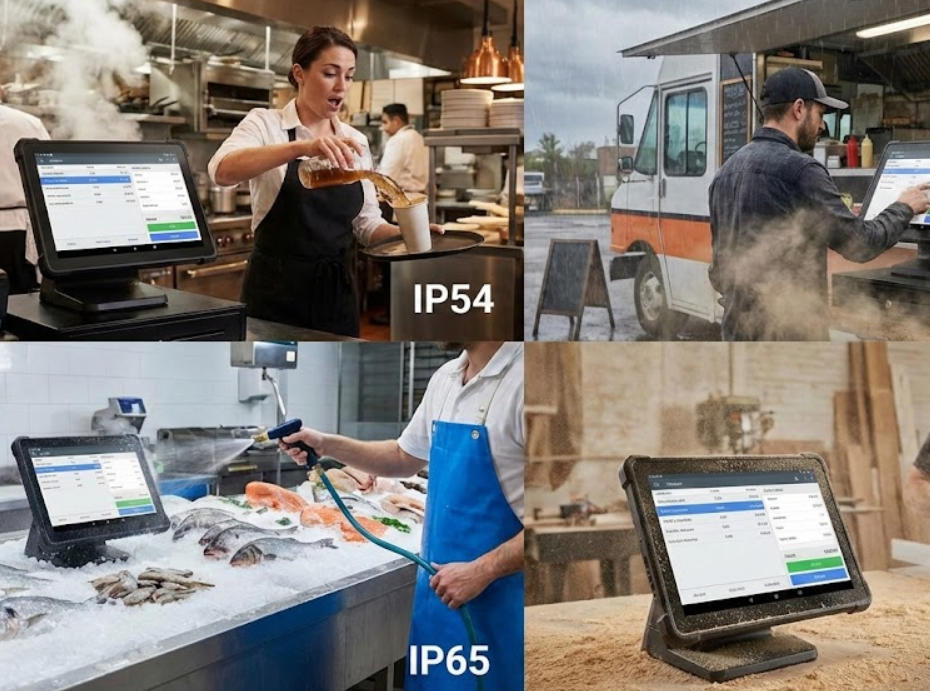
Do POS terminals have waterproof and dustproof ratings? (IP54 / IP65) Which industries require this?
Jan 17, 2026
Let’s be honest: the average retail environment is a minefield for electronics. If you’ve ever watched a server’s face go pale as a pint of beer tips toward the register, or seen a food truck owner scramble to cover their gear during a sudden downpour, you know that "standard" office tech just doesn't cut it in the real world.
That’s where IP ratings come in. But before you spend extra on a "rugged" machine, you need to know if you're buying genuine protection or just a fancy marketing label.
First things first: What do these numbers actually mean?
When we talk about "IP" (Ingress Protection), we’re looking at two specific numbers that tell a story about the terminal’s armor.
IP54 (The "Daily Hustle" Guard): The '5' means it can handle dust without the internals getting choked up. The '4' means it can survive splashes from any angle. It’s not meant to be submerged, but it can handle a clumsy spill or a damp cloth wipe-down.
IP65 (The "Heavy Duty" Shield): This is a step up. The '6' means it is 100% dust-tight—nothing is getting in. The '5' means it can handle low-pressure water jets. If you need to spray your counter down at the end of the night, this is your rating.
Which Industries Actually Need This?
Not every business needs a "tank" on their counter. If you run a high-end boutique selling silk scarves, a standard terminal is fine. But for the following industries, an IP rating is essentially an insurance policy for your uptime.
1. Restaurants, Bars, and Busy Kitchens
Between the steam in the kitchen and the liquid chaos of a busy bar, humidity is the silent killer of POS systems. An IP54 rating is usually the sweet spot here. It protects the motherboard from the sticky residue of soda spills and the fine mist of cleaning sprays used during a shift change.
2. Food Trucks and Outdoor Markets
Outdoor vendors are at the mercy of the elements. Wind-blown dust can get into the ports of a standard iPad or basic register, causing it to overheat or fail. Moreover, if you’re operating a food truck, an IP65 rating gives you peace of mind that a sudden rainstorm won't end your business day prematurely.
3. Seafood Markets and "Wet" Retail
If your business involves ice, raw product, or constant washing—like a butcher shop or a florist—you are in a high-moisture zone. Here, an IP65 terminal isn't a luxury; it’s a requirement. You need a device that can be sanitized thoroughly without water seeping behind the glass.
4. Manufacturing and Workshops
In environments where sawdust, metal shavings, or fine powders (like flour in a large bakery) are airborne, a standard cooling fan will suck that debris straight into the machine. A dust-tight IP6X rated terminal ensures the "brains" of your POS stay clean.
Is it worth the extra cost?
I get asked this a lot: "Why pay more for an IP65 screen when I can just be careful?" The reality is that "being careful" fails 100% of the time during a Friday night rush. The cost of a rugged POS is almost always lower than the cost of:
A mid-day hardware failure.
Emergency technician fees.
The loss of customer trust when you have to go "Cash Only" for three days.
If your POS System is going to live in a temperature-controlled, clean room, don't worry about it. But if your business is messy, loud, humid, or outdoors, look for at least an IP54 rating. If you expect to encounter direct rain or heavy cleaning, go for IP65.
FAQ: What You Need to Know
Q: Can I use a regular tablet if I put it in a waterproof case?
A: You can, but it’s a band-aid solution. Cases often cause tablets to overheat because they can't dissipate heat, and the touch sensitivity usually drops. A purpose-built IP-rated terminal is designed to stay cool while staying sealed.
Q: Does IP65 mean I can pressure wash my POS?
A: Absolutely not. IP65 handles low-pressure jets (like a tap or a light hose). High-pressure washers will force water past the seals. Always use a damp cloth and a gentle touch.
Q: Are these terminals harder to repair?
A: Sometimes, because the seals are very tight. However, they require repair so much less often that the trade-off is almost always worth it for a business owner.